
What Is Video Remote Interpreting? A Buyer’s Guide
A deaf patient arrives at an emergency room at 2 a.m. and needs an ASL interpreter immediately, not in two hours. A hospital in a mid-sized city needs a Mongolian interpreter for a single consultation, and no local freelancer is available. A courtroom needs to see the interpreter’s face and body language on the record, not just hear a voice. Video remote interpreting exists for exactly these situations, where audio alone isn’t enough and an in-person interpreter isn’t fast, local, or available.
This guide explains what VRI actually is, the specific technical standards US regulators and courts hold it to, who it works best for, and what to check before signing a contract.
Quick Answer
- Video remote interpreting (VRI) connects a live, professional interpreter to a conversation over a real-time video call, most often for sign language or for encounters where visual context matters.
- US federal regulations set specific technical requirements for VRI used with limited English proficient patients, covering video quality, image size, audio clarity, and user training.
- VRI is required, not optional, for many deaf and hard-of-hearing encounters under the Americans with Disabilities Act, unless the individual has a documented preference or need for in-person interpreting.
- Pricing generally runs higher than phone interpreting, commonly $1.50 to $7 per minute depending on scheduling lead time and contract volume.
- Bandwidth and hardware matter: courts and healthcare regulators publish minimum technical specifications that many buyers never ask their vendor to confirm.
What Video Remote Interpreting Is
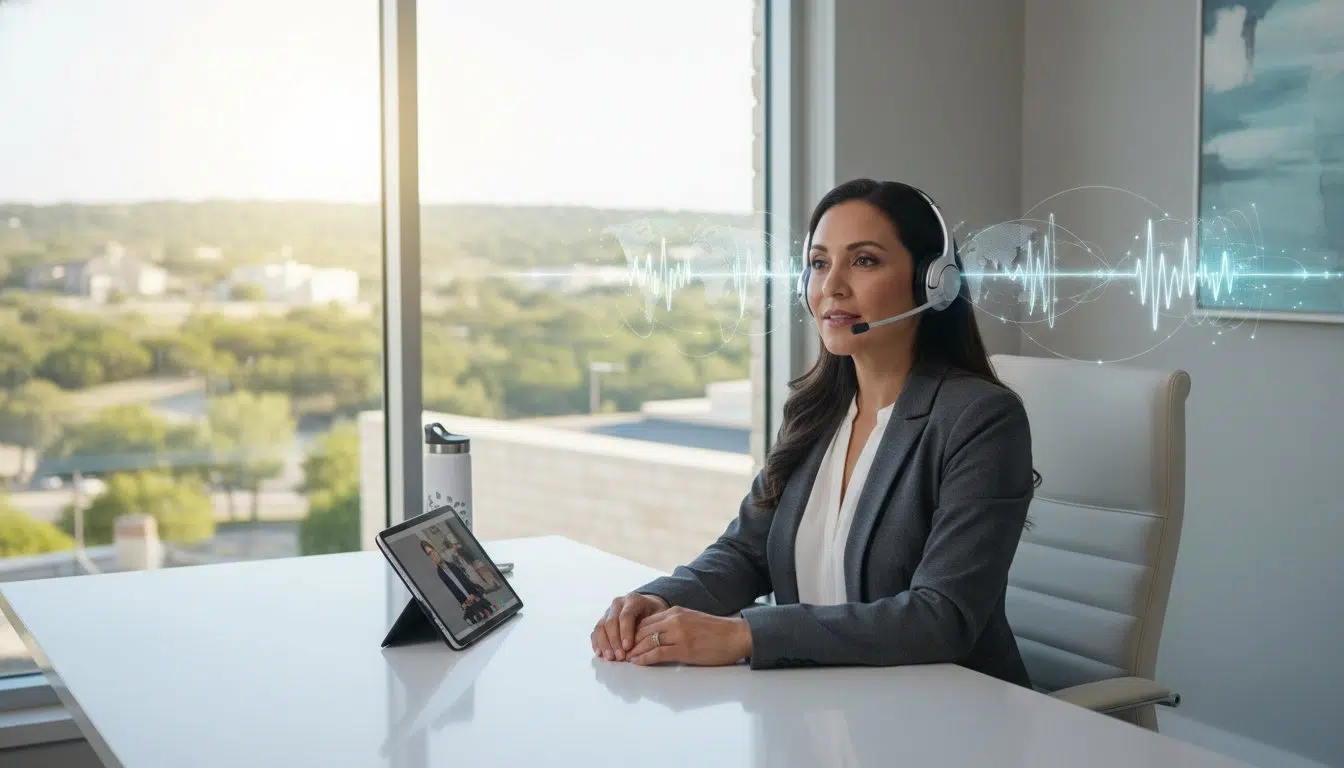
VRI is simultaneous or consecutive interpreting delivered through a live video connection rather than an audio-only call or an in-person interpreter. The interpreter appears on screen, sees the speaker and any visual material in the room, and interprets in real time. It is the standard delivery method for American Sign Language interpreting when an in-person ASL interpreter is not immediately available, and it is increasingly used for spoken-language interpreting in healthcare and legal settings where visual cues, documents, or patient affect genuinely change what the interpreter needs to convey.
The Federal Technical Standard Most Buyers Never Ask About
Few interpreting buyers realize that VRI used with limited English proficient patients is governed by an actual federal technical standard, not just a vendor’s marketing claims about video quality. Department of Health and Human Services regulations require that VRI used in covered health programs provide real-time, full-motion video and audio over a dedicated high-speed connection that does not produce lags, choppy or blurry images, or irregular pauses; a sharply delineated image large enough to display both the interpreter’s and the patient’s face regardless of body position; clear, audible transmission of voices; and adequate training for staff so the technology can be set up and operated quickly and efficiently.
Court systems publish even more specific hardware benchmarks. Ohio’s court rules on video remote interpretation, for example, specify that each device support at least 768 kilobits per second of video bandwidth, and that the computer used meet a 2 gigahertz processor, 3 gigabytes of RAM, a dedicated video card, and sufficient hard-drive space, with the computer dedicated to the interpreting session rather than running other software at the same time. Very few VRI buyers ever ask their vendor to confirm compliance with standards this specific, which makes it one of the easiest ways to separate a serious provider from one running a consumer video app with an interpreter attached.
When VRI Is Required, Not Just Preferred
Under the Americans with Disabilities Act, healthcare providers and other covered entities must provide effective communication for deaf and hard-of-hearing individuals, and VRI is an accepted method of doing so, but it is not unconditional. Individuals who assert in good faith that VRI is not providing effective communication, because of a language barrier, visual impairment, cognitive disability, or a poor experience with the technology in the past, cannot be compelled to use it in place of an in-person interpreter. Several state VRI rules explicitly prohibit using video interpreting for legally blind individuals and set separate consent requirements for minors.
How VRI Compares to Phone and In-Person Interpreting
VRI sits between over-the-phone interpreting and on-site interpreting on almost every dimension: faster to deploy than an in-person interpreter but slower and more resource-intensive than a phone call; more expensive than OPI but generally cheaper than dispatching someone physically to the location.
Industries and Scenarios Where VRI Is the Right Fit
- Emergency departments and urgent care, where a deaf or hard-of-hearing patient needs an ASL interpreter faster than one can be dispatched on-site
- Telehealth visits, where the clinician, patient, and interpreter are already meeting by video
- Courtrooms and depositions that require the interpreter’s facial expressions and demeanor on the record
- Rare-language encounters, across 300+ supported languages, where no local interpreter in any modality is credentialed in the needed language
- Educational environments, including IEP meetings, where on-screen review of visuals and documents is required (see Education Translation and Interpretation Services)
Certification to Look For in a VRI Interpreter
For American Sign Language, look for interpreters certified through the Registry of Interpreters for the Deaf (RID) or holding a state licensure where required; many state VRI rules explicitly require a qualified interpreter, not simply a fluent signer. For spoken languages delivered over video, the same national credentialing bodies that apply to OPI and on-site interpreting apply here: CCHI and NBCMI for healthcare, and state court certification consortia for legal settings.
Evaluating a VRI Platform Before You Buy
| What to Check | Why It Matters |
| Minimum bandwidth requirement | Substandard bandwidth produces the lagging, choppy video that federal VRI regulations explicitly prohibit |
| Screen and camera specifications | Image must be large and sharp enough to see facial expression and, for ASL, hand and finger movement clearly |
| Interpreter credentialing per language | Confirm the certifying body and credential level, not a general claim of certification |
| Device dedication | Some court and hospital standards require the device run VRI exclusively during a session, not alongside other software |
| HIPAA and data handling | Video sessions may be more sensitive than audio; confirm encryption and no unauthorized recording or storage |
| Failover to OPI | Ask what happens if video quality degrades mid-session; a strong provider can fail over to audio without dropping the call |
Frequently Asked Questions
Is VRI the same as a video call on a consumer app like Zoom or FaceTime?
No. A consumer video app provides the connection, but not the qualified interpreter, credentialing, compliance documentation, or technical guarantees that healthcare and court VRI regulations require.
Can a patient refuse VRI and require an in-person interpreter instead?
Yes, under the ADA and related state rules, an individual who in good faith states that VRI is not achieving effective communication generally cannot be required to use it in place of an on-site interpreter.
What internet speed do I need for VRI?
Federal healthcare guidance calls for a dedicated high-speed connection sufficient to avoid lag or pixelation, and some court systems set an explicit minimum around 768 kilobits per second per endpoint; ask your provider to confirm the specific threshold their platform requires.
Does VRI work for languages other than ASL?
Yes. Spoken-language VRI is increasingly used in healthcare and legal settings where visual context matters, though OPI remains more common for simple spoken-language conversations because it is faster and less expensive.
Final Word
Video remote interpreting is not simply a video call with an interpreter on it. It is a regulated service with real technical benchmarks, real credentialing requirements, and real limits on when it can replace an in-person interpreter. Buyers who ask a vendor to confirm bandwidth, image quality, and interpreter credentials against those benchmarks, rather than accepting a general claim of quality, end up with a system that actually holds up during an emergency room visit or a courtroom hearing.
Voxivera’s video remote interpreting services are HIPAA-compliant and ADA-accessible, built to the technical standards healthcare and legal settings require. Explore our ASL interpreting services or over-the-phone interpretation for encounters that do not require video, or request a quote to compare options for your organization.